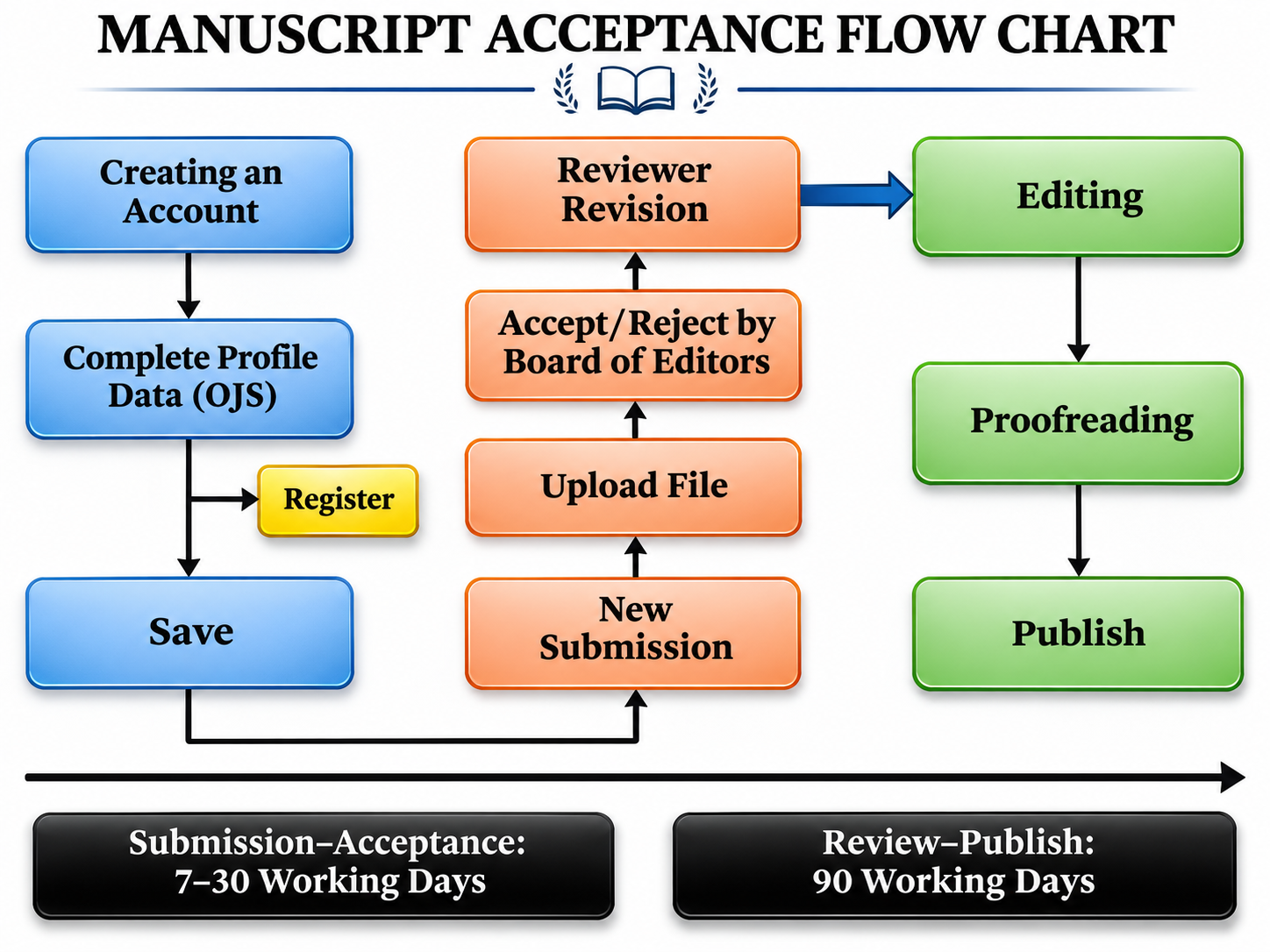
MANUSCRIPT ACCEPTANCE FLOW
Manuscript Acceptance and Publication Procedure
1. Editorial Decision and Manuscript Revision
Submitted articles will be declared accepted, rejected, or require further correction before finally being declared truly accepted. This decision will be announced within 7 to 30 days after the article is received through the OJS (Open Journal Systems) system. If improvements are needed, the author will be given time to make revisions according to the suggestions or comments provided by the reviewer. Articles will only be considered accepted once all necessary improvements have been completed and the article meets the standards set by the journal.
2. Diamond Open Access and No Publication Fees
Indonesian Civil Law Review (ICLR) operates under a Diamond Open Access publishing model, ensuring that scholarly articles are published and made freely accessible without imposing financial charges on authors or readers. The journal does not charge manuscript submission fees, Article Processing Charges (APCs), peer-review fees, editorial processing fees, publication fees, DOI assignment fees, or any other mandatory publication-related charges.
Authors are not required to make financial donations, development contributions, or other payments as a condition for manuscript submission, editorial evaluation, acceptance, or publication. All editorial decisions are based exclusively on scholarly merit, originality, methodological rigor, relevance to the journal's aims and scope, compliance with publication ethics, and the outcomes of the independent peer-review process.
The journal's operational activities are supported by PT Makanja Group Publishing and voluntary, non-commercial contributions from members of the scholarly community. Such contributions are not mandatory and do not influence manuscript evaluation, reviewer selection, editorial decisions, or publication outcomes. The journal maintains full editorial independence and ensures that authors receive equal treatment regardless of their financial circumstances.
Under this publishing model, all accepted and published articles are made freely available to readers immediately upon publication, without subscription fees, access charges, or embargo periods, in accordance with the journal's applicable open-access and licensing policies.
Article Processing Charge (APC): None
Submission Fee: None
Peer-Review Fee: None
Publication Fee: None
DOI Assignment Fee: None
3. Peer Review and Previously Published Conference Papers
All manuscripts submitted to journals are subject to a peer review process and are expected to meet academic excellence standards. If approved by the editor, submissions will be considered by the reviewer on a double-blind basis, where the author's personal identity will remain anonymous to the reviewer.
If your article is based on a conference or seminar article that may have been published elsewhere, it is important to note the following: The submitted article must be substantially revised, expanded, and rewritten so that it differs or is substantially different from the seminar paper or conference presentation on which it is based. The article must be sufficiently or completely different so that it becomes a new original work.
As a guide, more than 75% of the material or content must be new. This will be judged based on a comparison between the submitted article and the original conference or seminar paper. Original conference or seminar articles must be provided by the author of the expanded article for comparison purposes.
All articles will go through the same review process as other submitted articles. If the original conference article on which the expanded article is based has been published elsewhere, or copyright has been granted to the conference organizer or other party, the author must ensure that the necessary permissions have been obtained from the copyright owner. Articles will not be accepted for publication after the review process unless written permission is granted along with the article.
4. Further Information and Guidelines
For further explanation, please visit the following document:
Manuscript Acceptance Workflow